Guides
What Is Bitcoin and How Does It Work?
Nov
Table of Contents
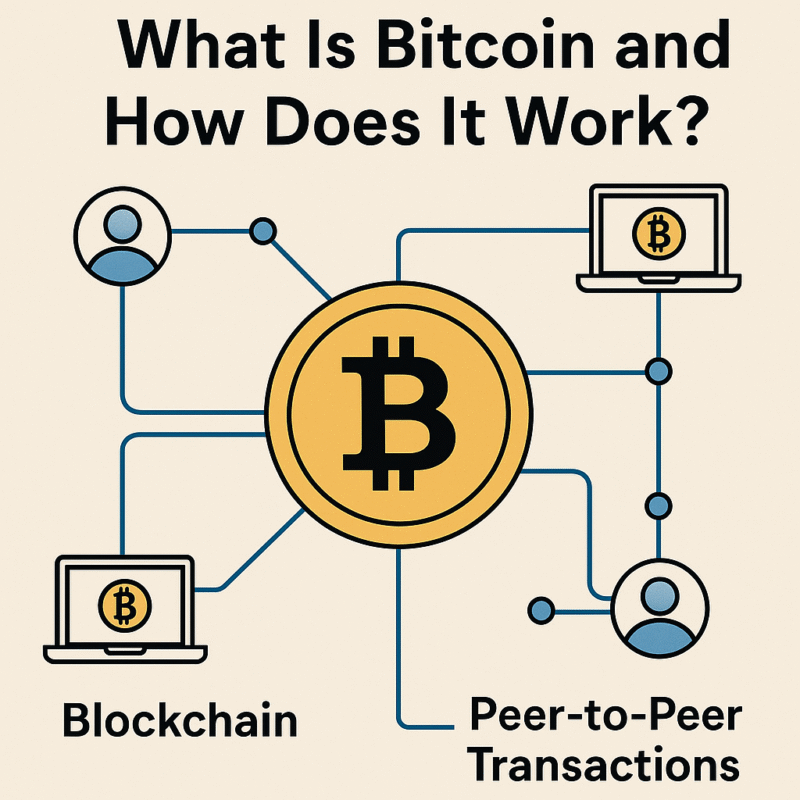
What is Bitcoin and how does it work? Bitcoin is a decentralized digital currency that operates on a peer-to-peer network using blockchain technology. It allows users to send and receive money globally without banks or governments by recording transactions on a secure, public ledger known as the blockchain.
Understanding Bitcoin: What is Bitcoin and how does it work ?
Bitcoin (BTC) is the world’s first cryptocurrency — digital money that isn’t controlled by any single authority. Instead of relying on banks, it uses a network of thousands of computers (called nodes) that verify and record every transaction.
Unlike traditional currencies such as the euro or dollar, Bitcoin’s supply is limited to 21 million coins, making it resistant to inflation and political interference.
Bitcoin’s decentralized nature means no single person, bank, or government can manipulate it. Instead, the system relies on cryptography, mathematics, and community consensus to maintain security and trust.
How Bitcoin Works (Step-by-Step)
At its core, Bitcoin is simply a ledger of transactions shared across thousands of computers worldwide. Here’s how it works in practice:
- A user initiates a transaction — for example, sending 0.1 BTC to another wallet.
- The transaction is broadcast to the Bitcoin network.
- Miners validate the transaction by solving a cryptographic puzzle (Proof of Work).
- Once verified, the transaction joins a block and is permanently added to the blockchain.
- The receiver sees the Bitcoin appear in their wallet after confirmation.
This process repeats roughly every 10 minutes, ensuring security and transparency for every movement of funds.
Learn more in How Bitcoin Mining Works – Complete Beginner’s Guide.
The Technology Behind Bitcoin — Blockchain Explained
Blockchain is the revolutionary technology that makes Bitcoin possible. Think of it as a shared public ledger or an open-source digital notebook that anyone can verify but no one can alter.
Each “block” stores transaction data, a timestamp, and a cryptographic hash of the previous block — forming an unbreakable chain.
Bitcoin uses the SHA-256 algorithm, a secure encryption standard that ensures data integrity and prevents fraud.
Learn more about blockchain structure at NIST Blockchain Basics.
The History of Bitcoin
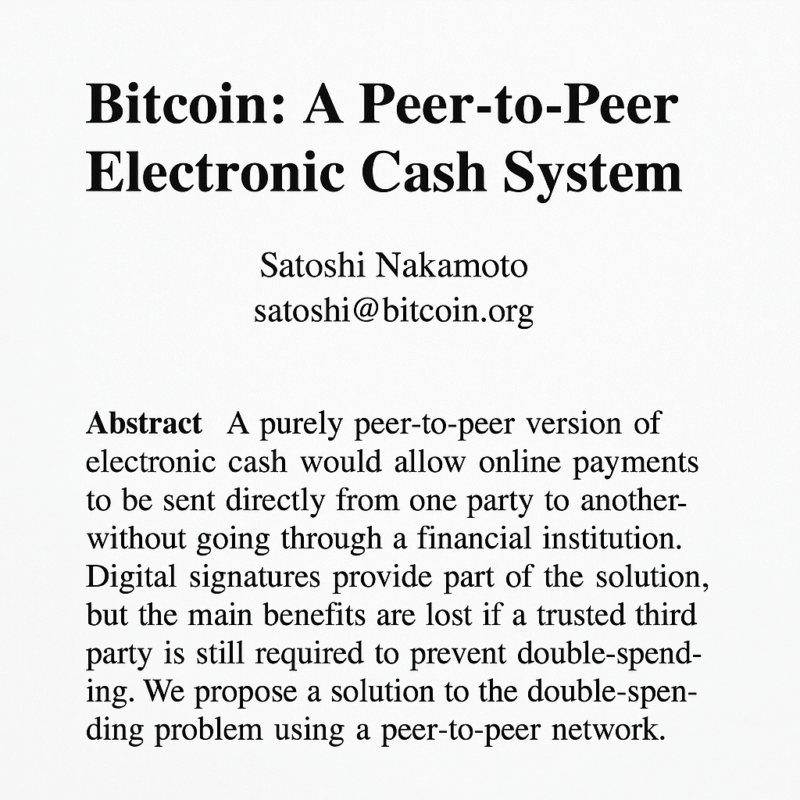
Bitcoin was introduced in 2008 by an anonymous person (or group) under the pseudonym Satoshi Nakamoto, who published the whitepaper “Bitcoin: A Peer-to-Peer Electronic Cash System.”
On January 3, 2009, Nakamoto mined the Genesis Block, embedding the now-famous message:
“The Times 03/Jan/2009 Chancellor on brink of second bailout for banks.”
This was a statement against centralized banking — the core reason Bitcoin exists.
Since then, Bitcoin has grown from being worth just fractions of a cent to trading above $100,000 USD in 2025. Its network processes hundreds of millions of transactions every year and inspires thousands of other cryptocurrencies.
Bitcoin Mining Explained
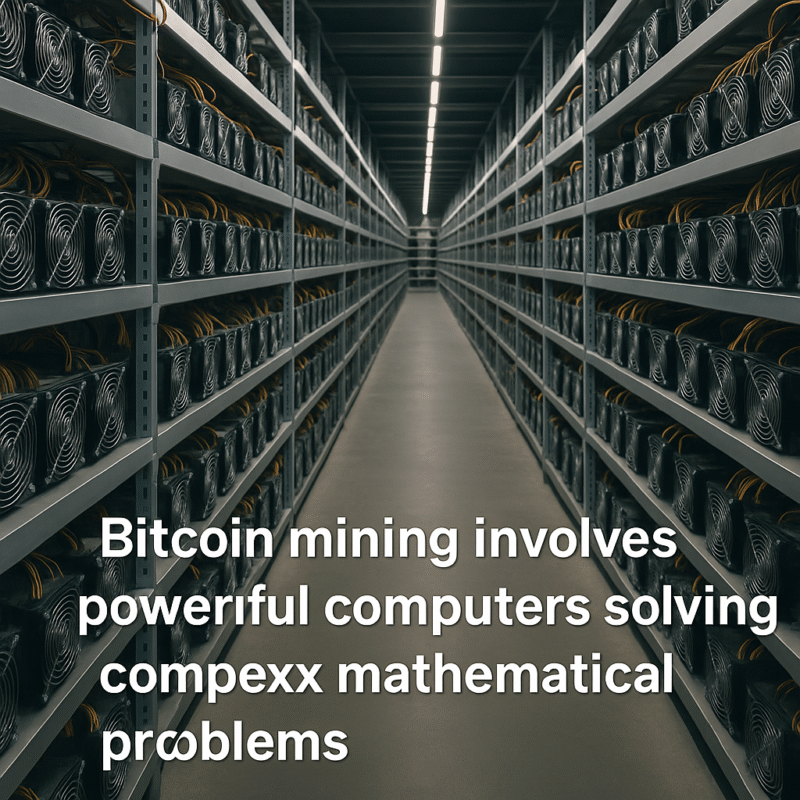
Bitcoin mining is the process that secures the network and issues new coins. Miners use specialized hardware — ASICs (Application-Specific Integrated Circuits) — to solve complex mathematical puzzles.
When a miner solves a block, they add it to the blockchain and earn a block reward (currently 3.125 BTC as of 2025). Every four years, this reward is halved, limiting Bitcoin’s supply and mimicking gold scarcity.
Key Mining Facts (2025):
- Network hash rate: ~920 quintillion hashes per second
- Block time: 10 minutes
- Reward halving: Next in mid-2028 → 1.5625 BTC per block
Mining requires powerful, efficient equipment and low-cost electricity. Common ASIC models include the Bitmain S19 XP, Whatsminer M50S+, and Aladdin L2 30 TH/s.
Internal link: Explore available miners at Buy Bitcoin Miners – Crypto Miner Shop.
External link: CoinMetrics Bitcoin Hashrate Chart.
How to Buy Bitcoin
Buying Bitcoin is easier than ever. You can use trusted crypto exchanges, payment apps, or peer-to-peer platforms.
Step-by-Step:
- Choose a reputable exchange – Binance, Coinbase, Kraken, or Bitstamp.
- Verify your identity (KYC) for security.
- Deposit fiat currency (USD, EUR, GBP etc.).
- Buy Bitcoin (BTC) — you can purchase fractions, even €10 worth.
- Transfer Bitcoin to a secure wallet (hardware or software).
External link: Bitcoin.org – How to Buy Bitcoin.
How to Use Bitcoin
You can use Bitcoin to:
- Pay for goods or services online/offline
- Send money internationally in minutes
- Invest or trade on crypto markets
Merchants like Microsoft, Overstock, and Newegg already accept Bitcoin. Many small businesses integrate QR payment systems using crypto wallets.
To use Bitcoin safely:
- Store it in a hardware wallet (Ledger Nano X, Trezor Model T)
- Enable 2-factor authentication
- Keep private keys offline
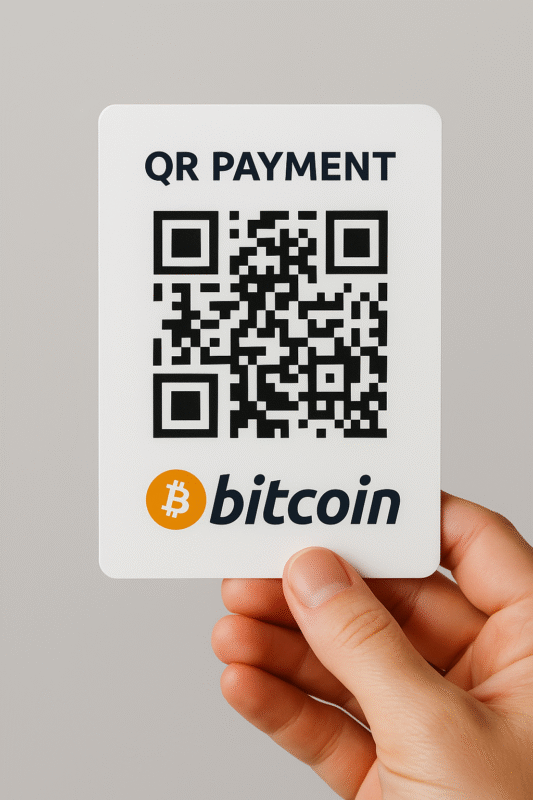
External link: Bitcoin.org/en/spend-bitcoin.
Investing in Bitcoin: Benefits and Risks
Bitcoin is both a currency and an asset class. Investors buy it as a hedge against inflation or as a speculative store of value.
Advantages:
✅ Limited supply (21 million BTC)
✅ Global accessibility 24/7
✅ No bank fees or middlemen
✅ Portability — you can carry millions on a USB wallet
Risks:
⚠️ High volatility (prices can swing 20% daily)
⚠️ Exchange hacks and fraud risks
⚠️ Regulatory uncertainty in some regions
⚠️ Irreversible transactions — mistakes can’t be undone
Bitcoin Regulation Around the World (2025 Update)
| Country | Legal Status | Regulation Body | Key Policy |
|---|---|---|---|
| USA | Legal / Regulated | SEC (Project Crypto 2025) | Clarifies crypto as commodity |
| EU | Legal | EU Commission (MiCA 2023) | Unified crypto framework |
| India | Restricted | Reserve Bank of India | Partial exchange ban |
| Canada | Legal | FINTRAC + CSA | Exchange licensing required |
| China | Banned | PBoC | Mining and trading prohibited |
External link: EU MiCA Regulation 2023.
FAQs
Q1: What exactly is Bitcoin in simple terms?
Bitcoin is a digital form of money that operates on a decentralized network instead of banks.
Q2: How does Bitcoin make money for miners?
Miners earn Bitcoin rewards for validating transactions and maintaining network security.
Q3: Can you convert Bitcoin into cash?
Yes — through crypto exchanges, ATMs, or peer-to-peer trades.
Q4: Is Bitcoin safe?
The blockchain itself is secure, but users must protect their private keys and wallets.
The Bottom Line
Bitcoin isn’t just an investment — it’s the foundation of a new, decentralized financial system.
Understanding how it works helps you appreciate its potential to reshape money and finance worldwide.
Ready to get started?
👉 Explore ASIC Miners for Bitcoin Mining
👉 Learn How Bitcoin Mining Works – Complete Guide
